
2025 Migration Trends and What They Mean for Commercial Real Estate
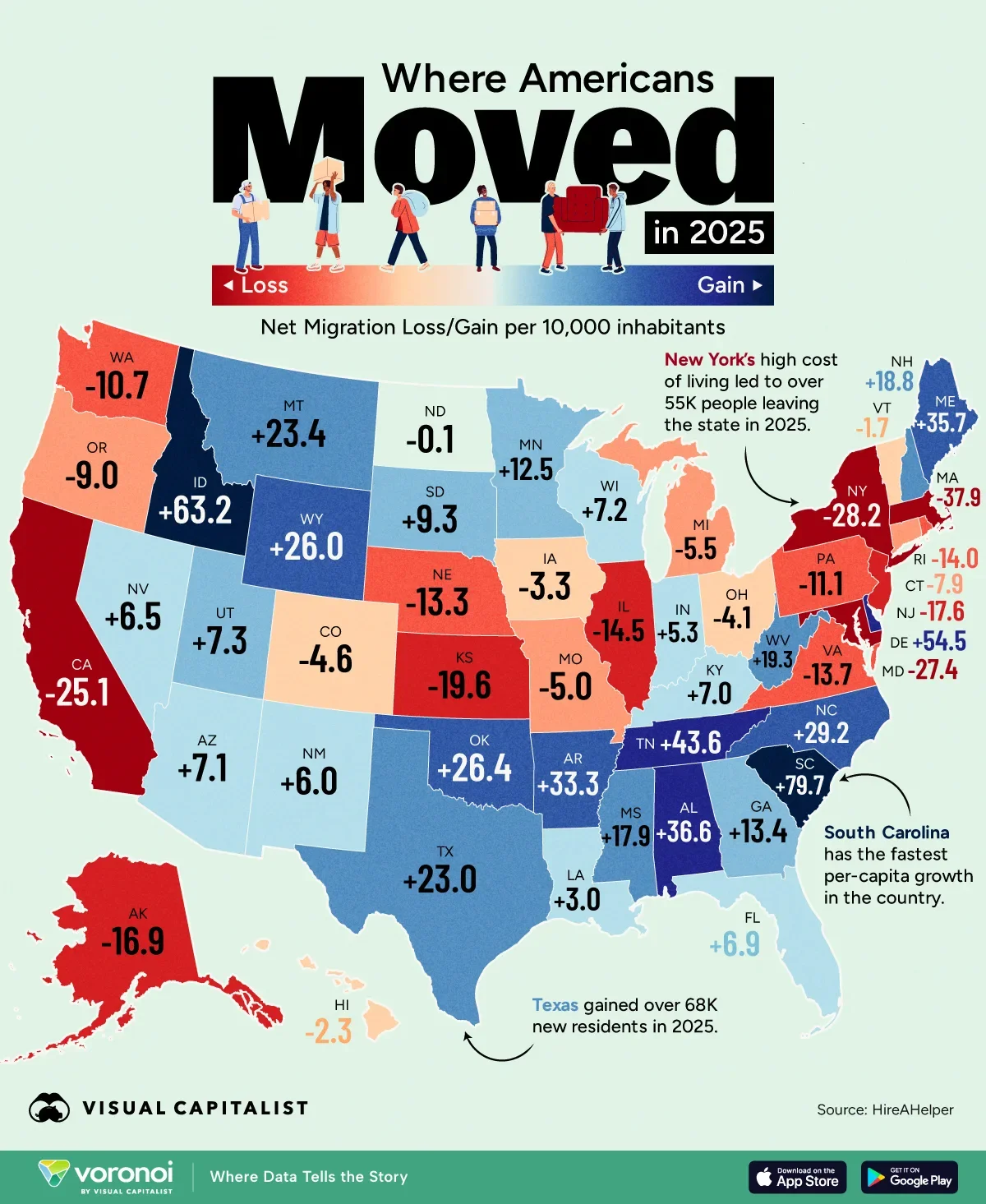
Recent migration data is reinforcing a trend we’ve been tracking for several years: population shifts are reshaping demand across key commercial real estate markets.
A new national map analyzing net migration per 10,000 residents highlights a clear pattern—continued movement toward the Southeast, parts of the Mountain West, and select Sunbelt markets, while high-cost coastal states continue to see outflows.
Key Migration Trends in 2025
Southeast markets are leading growth, with South Carolina, Tennessee, and Alabama ranking among the highest per-capita population gains
Texas continues to absorb the largest number of new residents overall, adding tens of thousands in 2025 alone
Mountain West states like Idaho and Wyoming remain top performers on a per-capita basis
Outflows persist in high-cost states, including California, New York, and Illinois
While this data is population-based, the implications for commercial real estate are immediate and measurable.
Why Migration Matters for CRE
Population growth is one of the most reliable leading indicators of real estate demand. As people relocate, they bring:
Increased need for office space and employment hubs
Higher demand for industrial and logistics facilities
Expansion of retail and service-oriented businesses
Pressure on infrastructure and mixed-use development
In short, where people go, capital and development follow.
The Southeast Advantage
The Southeast continues to benefit from a combination of structural advantages:
Lower cost of living relative to coastal markets
Business-friendly regulatory environments
Strong population inflows supporting long-term absorption
Availability of land for both residential and commercial development
Markets across Georgia, the Carolinas, and Tennessee are seeing sustained interest from both investors and occupiers looking to align with these trends.
What This Means for Investors and Occupiers
For investors, migration trends are a signal—not just of where growth is happening today, but where it is likely to persist.
Industrial assets in high-growth corridors remain a priority
Suburban office and flex space is gaining traction as companies follow workforce migration
Retail demand is stabilizing and expanding in growth markets with strong population inflow
Land and development opportunities are increasingly tied to migration-driven expansion patterns
For occupiers, relocation strategies are becoming more aligned with workforce accessibility and long-term cost control—both of which are directly influenced by migration patterns.
Looking Ahead
Migration is not a short-term anomaly—it is a structural shift. As cost pressures, lifestyle preferences, and remote work flexibility continue to influence decision-making, these patterns are expected to persist.
For commercial real estate stakeholders, understanding where people are going—and why—remains critical to making informed, forward-looking decisions.
Source: Visual Capitalist / U.S. Migration Data (2025)