Migration to the Sunbelt States Brings More Real Estate Investors

 
Blog image Template copy.jpg
 

In 2020 commercial real estate transaction volume dropped 64% year over year according to Real Capital Analytics. As we move further into 2021, real estate investors have seemingly set their sights on the Sunbelt States. The Sunbelt States check two important boxes for commercial property investors:

  1. Job growth 

    In Milken Institute’s Best-Performing Cities 2020 Where America’s Job’s Are Created and Sustained, Sunbelt Cities make up 15 of the top 25 cities for job growth in 2020.

  2. Increased population

    The Sunbelt region runs from the Southeast to the Southwest. It is made up of eighteen states and according to Moody’s Analytics, the population growth over the last ten years in the Sunbelt region accounts for 75% of the population growth in the country. Clarion Partners predicts that 55% of the US population will be in the Sunbelt region by 2030.

    The US postal service verified over 300,000 have fled the five boroughs in New York with the change of address requests outside the city. Cities will face huge deficits with these wage earners leaving as 75% of these people earn over $100k per year. These wage earners pay 80% of all taxes collected by these cities.

Job growth and Increased population are two huge factors when looking at investing in real estate. Investors are chasing higher yields or capitalization rates in growing markets like Charlotte, Raleigh, Greenville, Boise, Phoenix, Jacksonville, Dallas, etc. We are seeing annual returns in these secondary cities return 1%-4% increase over the cities with negative growth rates.

 In addition to job growth and increased population, politics is also playing a part in the Sunbelt States commercial real estate investment upswing. The Biden administration is considering eliminating the 1031 exchange concept from commercial real estate investment. The 1031 exchange tax laws allow an investor to put off gains and roll capital gains into another investment if done in a 120 day period after their sale. This threat of paying higher taxes has in turn created a flurry of property buying activity among real estate investors in cities like Atlanta, Phoenix, Dallas, and Houston

We expect the popularity of the Sunbelt will continue to flourish. As an Atlanta-based commercial real estate firm we are excited to see the job growth, population growth, and the flurry of commercial real estate buying.

3 Pandemic Influenced Trends In Commercial Real Estate

 
3+Pandemic+Influenced+Trends.jpg
 

1. Workspace changes 

Based on the Center for Disease Control (CDC) recommendation to maintain a six foot social distance, many companies will be making changes to their office space before reopening. What are some things we are recommending our clients consider?

What is your daily maximum capacity? Rearranging your workspace may not be possible. Once you have determined which desks can be utilized and additional areas, like conference rooms, have been converted into additional desk space or left as is, what is the maximum number of employees that can safely occupy your office space?

What is the cost? Each company will have to decide how much to spend and where. The health and safety of employees is at the forefront. We advise our clients to ask their landlord what  protocols have been implemented for their safety and what ongoing initiatives are planned to continually promote health and wellness. 

Who’s the authority for oversight and accountability? Once you have reconfigured your office space to ensure your employees are safe, consider appointing a “Pandemic Officer”, ideally with decision-making authority, to answer questions, make sure office space continues to meet CDC guidelines and employees are considering the safety of others.

2. Increase in available subleases

At Wildmor Advisors, we are actively tracking the submarket subleasing fluctuations, as well as vacancy rate changes since March 16, 2020. The amount of available sublease office space on the Atlanta market has increased by 3.8% over the past 60 days. Our clients who are subleasing office space at this time are doing so as a cost recovery strategy. Besides cost savings, what are some other things to consider before deciding to sublease your space?

How much office space do you need? This is the million dollar question most of our clients are seeking an answer to. Many companies have reported employees being more productive and happy working from home. Can those companies realistically plan to part with the extra square footage or even forgo office space all together? Large companies that have announced their employees will be working from home for the foreseeable future, haven’t made any major real estate changes yet. As we see shifts in the commercial real estate market, we will continue to update our clients.

Sublease recovery? Now that we have seen a spike in sublease activity (39 new office space subleases totalling 2,244,879 square feet have been added to the Atlanta market in the past 60 days), our clients need to consider how their space compares with other available subleases and the recovery they can expect. Wildmor specializes in helping our clients strategically analyze the various scenarios associated with subleasing all or a portion of their office space.

3. Rise in demand for Industrial Space 

According to Adobe’s Digital Economy Index, e-commerce was up 49% in April, compared to the baseline in early March when the stay at home orders were not fully in place. As e-commerce ramps up, manufacturing and distribution companies are looking to expand their warehouse/industrial operations to keep up with demand. Atlanta has more than 400 million square feet of Industrial space and is the second leading city in the U.S. for this real estate class. What should you consider if you’re looking into acquiring additional industrial space?

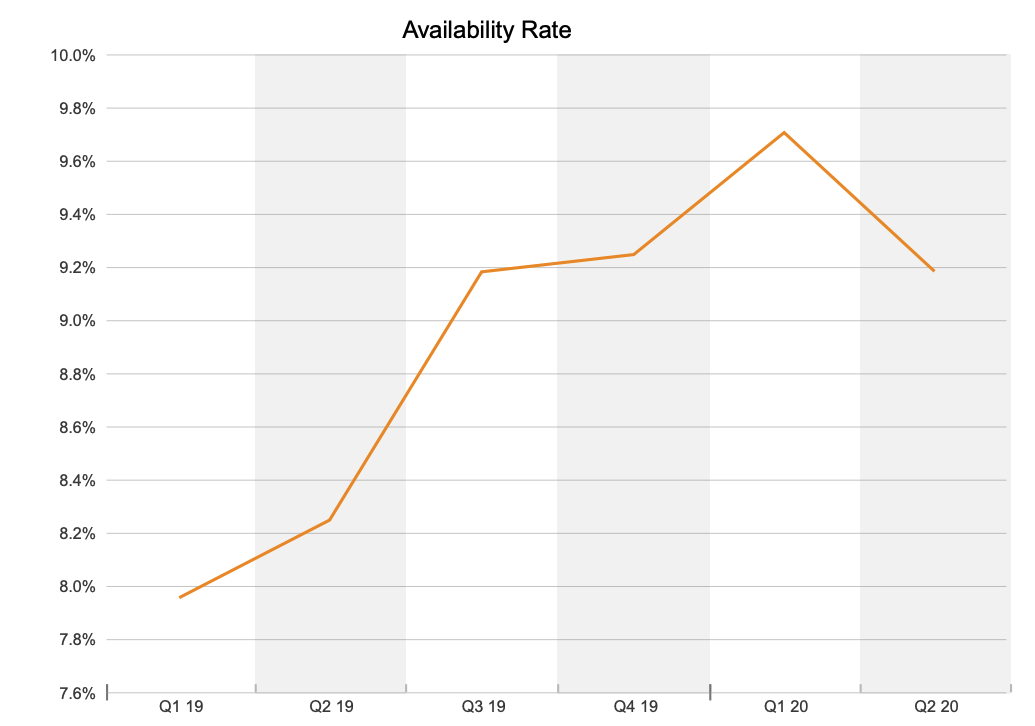
Will the amount of available Industrial space on the market decrease? We believe that it likely will. The graph below is the availability rate of industrial spaces in the greater Atlanta area. We did see a brief spike in mid Q1, but are expecting to see the availability of industrial space trend downward in months to come.

Screen Shot 2020-05-29 at 3.27.19 PM.png

How much leverage is there for negotiations? Due to basic economic supply and demand factors, tenant leverage could tighten in negotiations for a more limited supply of available industrial space. Overall, the asking rental rates per square foot for industrial space are expected to continue to increase through Q2 of 2020.

The Cost of Working Remote: Companies and Employees

 
The Cost of Working Remote.jpg
 

Over the past year, many companies have explored working virtually and have experienced first hand the many benefits that remote work has for both companies and employees. We have even written about these benefits in our previous blog posts. However, there are also many costs that remote work has on companies and employees that weren’t so evident a year ago. 

Companies that transitioned their employees to remote work likely saved hundreds of thousands of dollars on overhead costs (snacks, coffee, office supplies, utilities, etc.). While saving this much money sounds like all rainbows and butterflies (we love a good “company saves money” story, in fact, we save clients hundreds of thousands of dollars for a living), there are certainly other costs that companies are paying to have their employees remote. Some of these costs are: 

The Cost of Culture/Communication: How do you create a sticky remote work culture? This is what many of our clients have been trying to figure out this past year. In 2020, Google saw a 9% increase in searches related to “team-building”. It’s no surprise that many companies have struggled with creative team-building activities when workers can’t gather in a central office. 

In addition to company culture, communication within companies that have moved remote has also been an issue. 20% of remote workers have identified communication as an issue within their company. Yes, there have been numerous technologies emerging in the “office communication” space for this reason, but communication problems within companies still persist. 

The Cost of Women Leaving the Workforce: Working, parenting, domestic duties, and staying healthy has taken a toll on many professional women. In September, 617,00 women left the workforce (mostly between the ages of 35 to 44) compared to 78,000 men. Even before the pandemic, women were at an increased risk of mental health problems due to challenges in keeping all areas of their lives in balance. And companies that choose to go fully remote permanently do run a risk of losing women in their workforce. 

Security Cost: Remote workers need to access company systems, and data from their homes using a wireless connection. It’s no surprise that 54% of IT professionals say that remote workers are a greater security risk. 62% of security incidents related to WiFi connection happen while employees are not working in the office. Remote workers have a higher threat of using unsecured wifi networks, using personal devices and networks, and being targeted by work-from-home scams. 

For many employees, the saying “the grass is always greener on the other side” couldn’t be more true as many employees who have dreamed of working remotely found themselves doing just that over the past year. The cost of commuting to and from work is nearly zero and more time can be spent with family and loved ones on workdays lowering child care costs for remote employees. While the commuting and child care costs have shrunk, other costs have expanded enormously for remote workers. Some of these costs are: 

Household costs: Living and working at home is not just keeping your bathroom well stocked with toilet paper. A survey by creditcard.com found that remote employees are spending about $108 more per month while working from home. Groceries are perhaps the most noticeably increased expense at an average of $182 more per month. 

Functional home office costs: A survey of 950 remote employees found that 12.6% of workers don’t have a dedicated workspace. Working from home likely required many of these employees to bulk up on their internet and phone data plans, purchase office chairs (how long can an employee actually last working on the living room couch?), desks, printers, ink cartridges, pens, paper, and sticky notes. 

Beyond the cost of technology and supplies is something a remote worker can’t buy. That is what we are calling the cost of tranquility. In a perfect world, an employee’s home office is a dedicated space that is soundproofed, equipped with state-of-the-art internet speed and connectivity, and safely tucked away from household chaos and clutter. This is not the case for most employees, and many have found themselves constantly distracted with kids, pets, bad internet connection, and all the other things tied to household chaos.  In fact, the survey of 950 remote employees found that 96% of workers find themselves participating in non-work related activities during the workday. The most common activities were cooking (59%), watching tv (55%), and doing laundry (52%). 

Health Cost: As we have previously covered in “What’s Your Health Culture”, the mental health for many employees over the past year has taken a downward spiral (20% of remote workers are struggling with loneliness). In addition to mental health, physical health, and overall hygiene are also a concern of a largely remote workforce. In the survey of 950 remote employees, 58% of employees reported getting too much screen time, 24% said they are overeating, 52% said they are undereating, and 22% admitted to declining personal hygiene. 

The bottom line is that when it comes to having a remote workforce there are hidden costs that many companies and employees are just now starting to see the effects of. While remote work is still very attractive for many companies and employees, offices still serve a purpose.
Amenities for the Post-Pandemic Workplace

 
Amenities for Post Pandemic Blog.jpg
 

Long before Covid-19, companies prioritized amenities to attract and retain top talent. Now, 10 months into the pandemic, commercial real estate buildings and developers are future-proofing their amenities to attract tenants looking to get their employees back into the office where health and safety are prioritized. The future of workplace amenities takes employee health and healthcare access seriously. In fact, the wellness real estate industry is estimated to be worth $134 Billion and growing 6.4% globally every year. The health-centric, future-ready, amenities you can start to expect in the post-COVID-19 workplace are: 

  1. On-Site Healthcare 

Buildings will look to partner with medical providers to offer healthcare and fully-equipped wellness centers as an amenity. On-site physicians and therapists, in addition to telehealth, will be available to tenants and their employees for a small membership fee. Wellness centers will be used to help both the mental and physical health of tenants. 

2. Health Centric Upgrades 

80 to 90 percent of our health outcomes are tied to where and how we live. Studies show that living our lives mostly indoors, surrounded by stale air and toxic chemicals is dangerous. Upgrading HVAC’s that focus on UV light and bipolar ionization, and new cleaning routines will be essential to compete for the future tenant. Hotels, cruise ships, and airlines were among the first after the pandemic hit to quickly adopt upgraded HVAC systems to purify the air. 

3. Open-air workspace 

Stretch your legs and get some fresh air. Balconies and open-air workstations will start to take a larger footprint in new developments based on rising tenant demand.  Fresh air and nature boost our cognitive function and leads to higher productivity and creativity. To create the ultimate optimized environment, buildings that offer this amenity will allow tenants to balance their workload with more outdoor workspace options. 

4. Health Tech 

Don’t want to touch a dirty elevator button? Touchless digital solutions will be implemented throughout these future-ready buildings. “Smart elevators” that don’t require you to touch a button, thermal temperature cameras, and cleaning robotics that understand space density are all technologies that already exist and are being implemented in buildings today. 


The news of a vaccine has provided great optimism for commercial real estate, but it’s clear that reopenings will be an extended process as the vaccine rolls out. As companies look at reoccupying their space, future-ready buildings that prioritize health and wellness will be a must-have for tenants in the post-pandemic future. 


Flexible: The Future Workplace

 
Blog image Template copy.jpg
 

We believe that the office is not dead, but the way offices are used has changed forever. For many companies, 2020 proved that work is not a place and that work can get done from anywhere. According to a Harvard Business Review article, not only are workers believed to be more productive at home, but they also have been able to focus on work that they find is important. In a ServiceNow survey, 92% of executives say the pandemic made their company rethink how they work and 87% of employees say it’s an improvement. Also, 88% of the businesses surveyed that went remote due to COVID-19 were able to reduce operating expenses. 

These statistics speak for themselves, remote work is here to stay and will be balanced with in-office work in the post-pandemic world. What does this mean for many of our clients, their employees, and commercial real estate? 

  1. Hybrid Office(s) 

    The workplace of the future will allow a more flexible work environment and work schedule. Architects and designers in commercial real estate will need to rethink how employees will interact with the workplace and how employees get work done. 

  2. Empowered Employees

    The workplace of the future will allow employees to choose where and how to do their best work. For some, being in the office hasn’t equated to being more productive. On top of productivity remote/flexible work has proven to lead to a significant increase in job satisfaction. 

  3. Beyond The Office Workplace Culture 

    The workplace of the future will focus on demonstrating company values and culture through a wider scope of channels. In our July blog post, Is Company Culture Canceled? we touched on ways to keep your employees engaged while working remotely. As the remote workforce grows, companies will have to navigate new ways of keeping employees engaged and accountable. 

While we believe that remote work is here to stay, it is also clear that as we look into the future, the office is not dead. In 2021 we expect to see some of our clients choosing to lease out more locations that are more convenient for their employees rather than have an HQ. We also expect some of our clients to expand their current office footprint to allow for more flexibility. At the end of the day, every company is navigating their future workplace a little differently. At Wildmor we are excited to help companies reimagine their new normal and plan their future workplace, because the future of work is now and the future of work is flexibility.