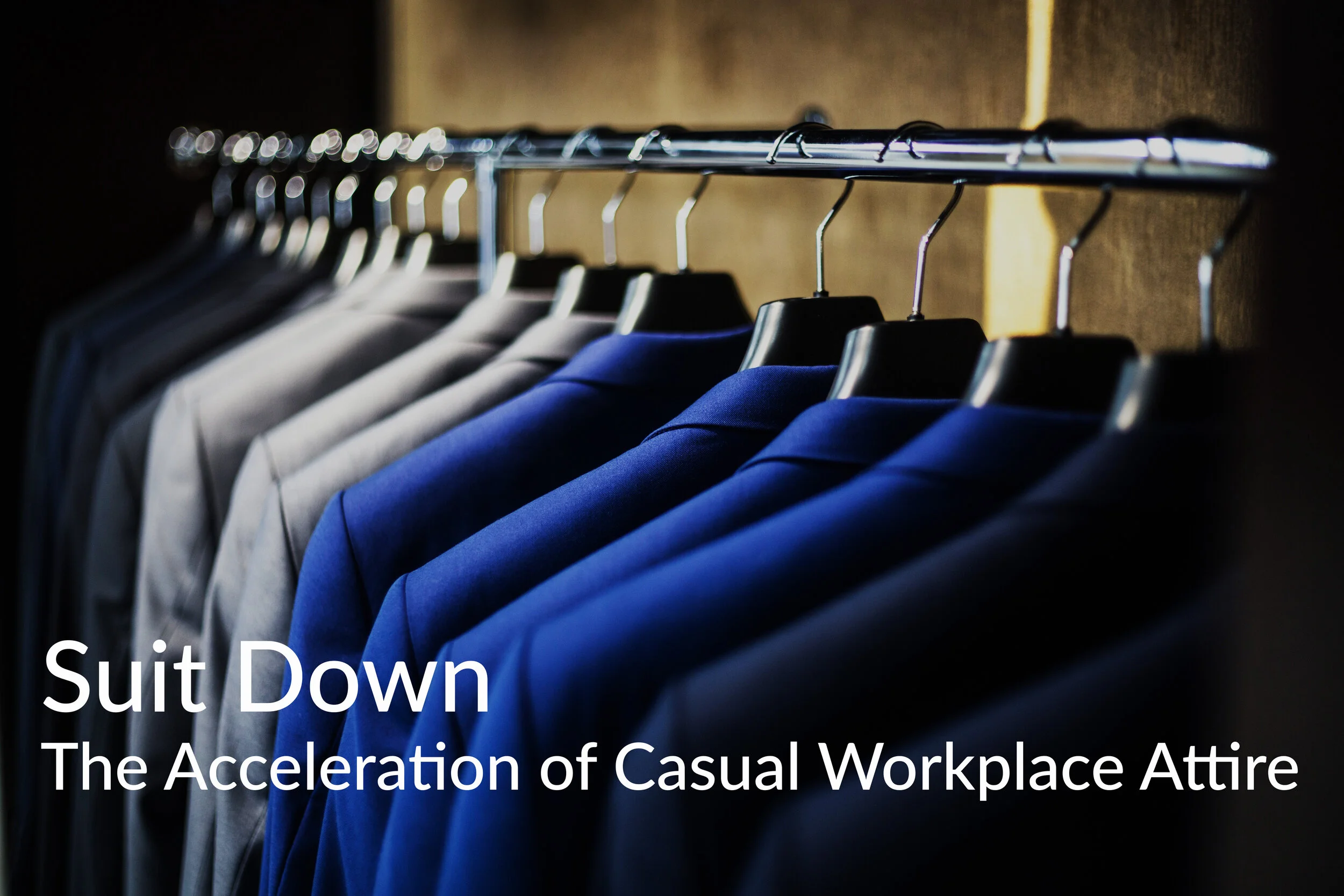
Suit Down - The Acceleration of Casual Workplace Attire

 
SuitDown.jpg
 

The day to day work routine has drastically changed for most Americans. With a limited workforce going into the office and face to face meetings shifting to an online format, the American wardrobe has shifted and changed as well.

In recent years, the workplace wardrobe has started to embrace casual dress codes. In many industries and companies, blue jeans have grown to be more acceptable. In fact, Goldman Sachs announced last year that they would be relaxing their dress code. Now that we are 8 months into the pandemic, remote workers have experienced the luxury of ditching their normal work attire for more casual, virtual conference call appropriate attire (AKA: athleisure wear). Will “suiting down” continue to be the new normal for employees post-pandemic? 

In July, CNN reported that office clothing is canceled and named 3 (of many) prominent retail groups that are in trouble due to the plummeted demand for office attire. Athleisure (clothing that blurs the line between gym clothes and everyday clothes) companies, however, have seen dramatic increases in sales in recent quarters. Lululemon reported an increase of 2% ($903 million in sales) in Q3 2020 compared to the previous year and Athleta saw a 6% increase in sales. 

During the pandemic, employers have been more accepting of casual attire. As the workforce begins re-entry, it will be important to reconsider the dress code policies. This will be a great opportunity for employers to understand why they implemented that dress code in the first place and to figure out whether - and to what extent - to modify.


What’s Your Health Culture?

 
What's your health culture.jpg
 

Not long ago tech giants built campuses for the ultimate company culture experience. Potential employees flocked to these companies at a chance to receive the perks and be a part of their company culture. Now that these tech giants have announced work from home models for the foreseeable future, how are they going to differentiate themselves among other employers? 

As companies try to navigate their company culture to a virtual model, health culture has shifted to the forefront for many companies. There is currently a global mental health crisis, and to keep a company running like a well-oiled machine it takes happy and healthy employees. The pandemic has certainly taken a toll on the mental health of many Americans and below are some startling facts about the pandemic stressors your employees are facing. 

Our current reality is that the future is still uncertain. While there are many predictions of what that future will look like, another reality is that it looks different for each company and each employee. At Wildmor, we believe that your people are the center of your success and that creating a health culture will be an important building block for companies of the future. Reach out to us if you are interested in ideas on how companies are creating a health culture.

Investing in Commercial Real Estate During the Pandemic

 
IICRDTP.jpg
 

Investors need more than a gut feeling to jump into large investment opportunities. They need data to help support their investment decisions and to pinpoint the right opportunity. As the coronavirus pandemic continues to disrupt commercial real estate, many investors are unsure about how to identify a good opportunity and what data to trust. 

There are two types of investors that invest in commercial real estate; institutional investors and personal investors. Institutional investors like REITs, pension funds, and Insurance companies are most likely to invest in large office buildings, apartments, warehouses, and shopping centers. Of course, most are interested in using scale to leverage their purchasing power. The personal investor has just recently had access to this leverage through Crowdfunding (such as CrowdStreet and Investopedia), which allows small dollar amounts to be invested in larger projects that reach tens of millions of dollars.

As we look at personal investing in commercial real estate the focus is on asset classes that are tied to what is hot during the pandemic times. The cap rates for these assets that are for sale are between 4.5% for chain retail stores and 8.5% for individual retail stores. According to Propmodo, asset classes such as last-mile industrial and grocery based retail are among the more popular asset classes during the pandemic. 


Along with the asset class and location, the probability of a tenant to pay rent is a major contributing factor when considering investing in commercial real estate. Investing in a triple net asset, meaning the tenant pays for all taxes, insurance, and utilities along with most repairs absent of structural issues will move risks off the investor. Keep in mind that triple-net assets still are a risk, especially if the tenant ends up in default. 

So what type of commercial real estate are investors focused on during the pandemic? They are primarily focused on “essential” and “pandemic thriving” asset classes. The major data points needed to determine what real estate to buy are the location, type of structure, age of asset, condition of the asset and most importantly how stable is the tenant and what is the probability of them paying rent during your ownership period.

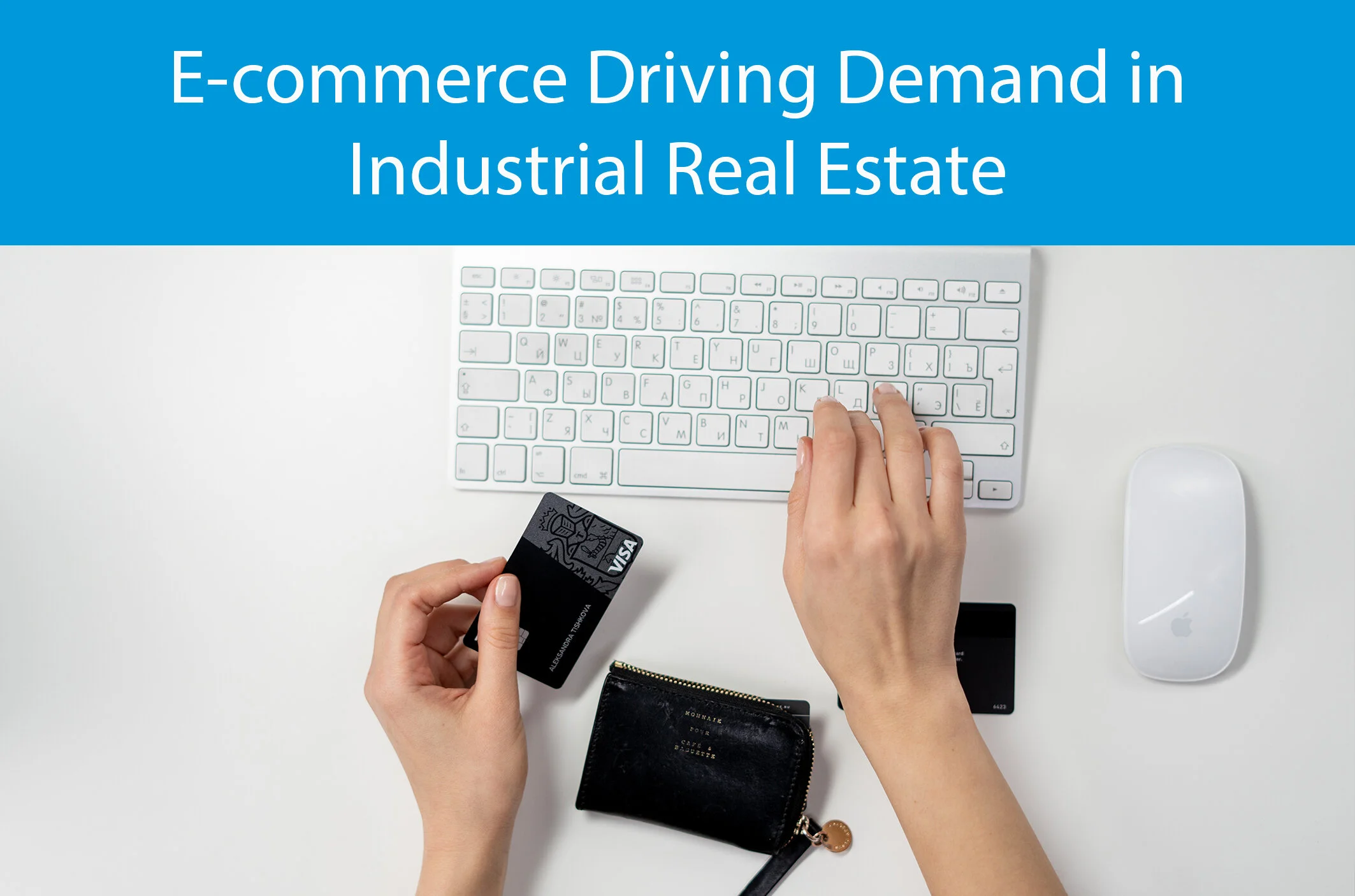
E-commerce driving demand in industrial real estate

 
E-commerce driving demand for ire.jpg
 

According to the most recent report from Digital Commerce 360, online sales surged at the start of the pandemic resulting in an increase of $60.42 billion (30.1%) in the first six months of 2020 over 2019. This growth is starting to level off as many stores begin to open; however, the year to year growth decreased from 76% in June to 55% in July.  This growth is expected to remain robust as more companies adopt a D2C (Direct to Consumer) model in their service offering.  

The increase in consumer e-commerce spending has precipitated a surge in demand for warehouses and distribution facilities across the US and abroad. Hamid Moghadam, Chairman of the board and CEO of Prologis, the largest owner and operator of industrial real estate in the US and Amazon’s primary Landlord, estimates that e-commerce represents 40% of their business. Prologis estimates that e-commerce customers need 1.2 million square feet of distribution space per $1 billion in company sales, which is three times the amount of space required by traditional distribution models.  Some industry leaders are estimating the need for an additional one billion square feet of distribution space in the next five years to accommodate e-commerce growth. In the second quarter this year, 78.2 million square feet of distribution space was delivered. 

 The most desirable inventory for last-mile players, which includes proximity to major metropolitan areas with adequate ingress/egress that can accommodate fleet vehicle parking, is limited and was before COVID.  That said, Amazon is repurposing big-box retail locations, something landlords would never have considered until the pandemic.  

 Emerging technologies reshaping warehousing and distribution facilities requirements:

While the pandemic has certainly accelerated e-commerce spending, it exposed significant supply chain disruptions resulting in a rise in product storage and a move to digital supply networks (DSNs) where innovative technologies are digitizing and connecting traditionally siloed processes.  According to a recent report by Gartner, the top 8 trends in supply chain technology in 2020 are:

  1. Hyper-Automation

  2. Digital Supply Chain Twin

  3. Continuous Intelligence

  4. Supply Chain Governance and Security

  5. Edge Computing and Analytics

  6. Artificial intelligence

  7. 5G Networks

  8. Immersive Experience

As companies adopt, refine, and develop these technologies and reimagine their operations, they are seeking to revolutionize industrial space, which is changing the way they evaluate and acquire industrial space.  As build-out costs increase, Landlords will need to share in these costs by increasing tenant improvement allowances.   

Real estate investors and operators have a unique opportunity to embrace emerging technologies in supply chain/logistics reshaping the industrial market.

Is Company Culture Canceled?

 
Is company culture canceled .jpg
 

With no end to the COVID-19 pandemic in sight, companies are re-evaluating their reopening strategy. Many companies have put re-entry plans on hold due to a recent spike of COVID across the country. Most employees will continue working from home for the foreseeable future and if there is an off chance they go back to the office, safety will be at the forefront limiting capacity of the office and person to person contact.

The longer employees work from home, the less connection they have with their co-workers and the company culture can begin to erode. A study by Gallup research found that “optimal engagement” occurs when employees spend 60 to 80 percent of their time working off-site (a 3-4 day work week). This means employees would still likely need a day or more on-site a week to reach “optimal engagement”. In addition, companies will have to work extra hard to build a connection with new hires that do not have a concept of what the company culture was prior to the pandemic. So is your company culture canceled?

No, your company culture isn’t canceled. Even as our working lives and hours are evolving, employees and their success should be top of mind. Below are three things to keep in mind as you navigate keeping your company culture alive while working remote.

1. Collaboration platforms

  • Be sure all employees have access to the same collaboration platform (i.e. skype, slack, zoom) for fast and seamless communication

  • Set Up fun communication channels. To encourage employees to connect socially, some businesses are setting up “WFH Channels” where employees are encouraged to post about what they are up to (i.e. workouts, pets, and hobbies). 

2. Flexibility

  •  Working from home means productivity should be emphasized over “normal” business hours. Let your employees help make decisions on when team meetings are scheduled.

3. Communication

  • Be very clear about when and how you expect employees to communicate. Now it’s easier than ever for employees to go MIA for extended periods of time. With employees no longer maintaining “normal” business hours, being clear on how they are expected to communicate is important.

Even after we have moved past the pandemic, many companies are planning to retain a significant work from home policy as part of their culture. Keeping employees and company culture top of mind is more important than ever, even if you plan on returning to the workplace in the coming months.

Reference: Wong, Kellie. "25 Key Remote Work Statistics for 2020." Achievers.com, 1 Apr. 2020,www.achievers.com/blog/remote-work-statistics/. Accessed 22 July 2020.